Thursday, September 29, 2011
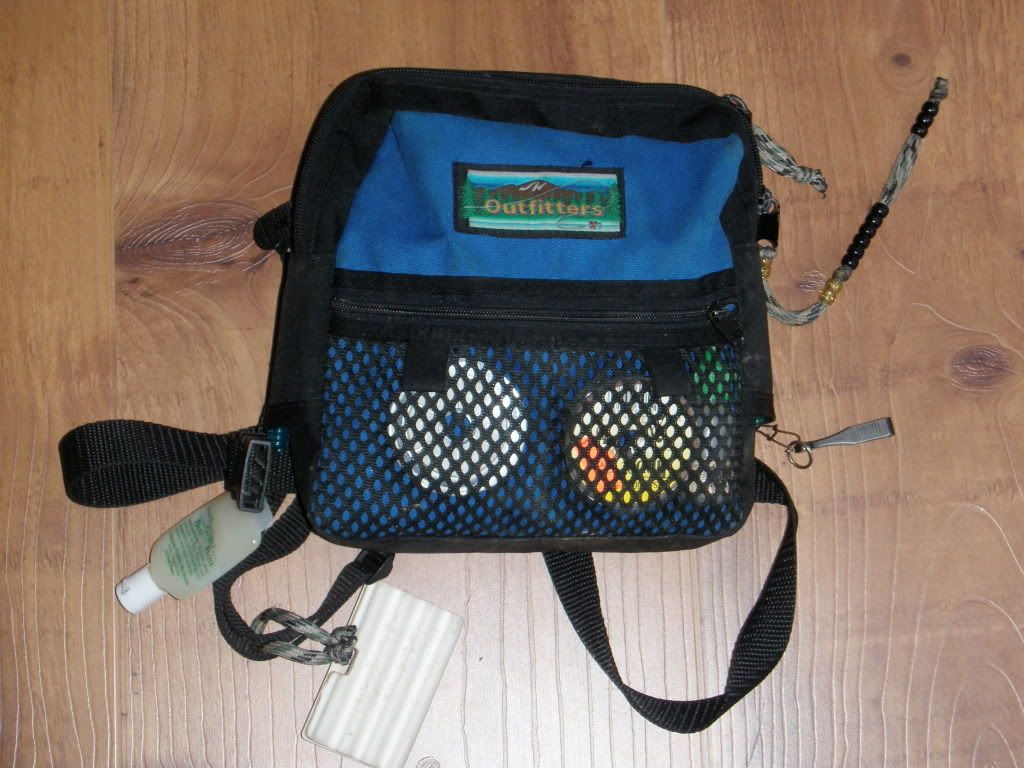
I'd be interested to hear what y'all use to carry your stuff. The chest pack I use is about 10"x10". To be truthful, it's larger than need be. As much as out of force of old habits, I still carry around 4 small fly boxes. I can't remember the last time I opened three of them. I pretty much have all my go to flies in one box and that's the only one that gets used. I also carry a pair of rarely used hemostats, a bottle of floatant, and a spool or two of tippet.


Saturday, August 20, 2011
Don't leave home without it

Wish I had been smart enough to think this up. I stole the idea from a fishing buddy. Good way to make sure you always have a grip pad handy. Of course it's best not to apply too much pressure when opening your rod, your rod should close without the need for too much pressure. However if you need to get a better grip, it's nice to have a pad handy -
Sunday, May 15, 2011
Both!
I learned an important lesson at a young age that I must have temporarily forgotten. When asked at a birthday party if one wanted cake or ice cream, the right answer is always – BOTH!
I think the same concept may have helped me to at least partially resolve a fishing related dilemma I’ve been tussling with for a while. I like to fish poppers for bluegills and bass in my local subdivision pond. Since I am shore bound, I’d like to be able to extend my range a bit, even though poppers tend to be a bit wind resistant when it comes to casting. So I’ve been in search of an optimal line to meet my desires.
I like the way normal length furled lines cast and fish. They have the mass to help deliver the bulkiness of the popper. Problem is, they become tedious to both furl and fish as the length of the line increases. The nice thing about level (fluorocarbon) lines, it’s easy to cut off longer lengths to increase range, but they don’t seem to have the mass to consistently cast bulky poppers.
So what is a poor boy to do? For some reason, I woke up the other day thinking about birthday cake and ice cream, and I realized, the fishing gods were talking to me. Why not try a combo line? Even though it was still early in the morning, I got busy tying up a combination line that started out with about a 7’ furled line, with a 12’ length of fluorocarbon. I added a 5-6’ leader/tippet, and was ready to go.
Soon as the sun started to come up, I was off to the pond to give it a whirl. After only a few days of field testing, I do like the way the combo line casts and fishes. I think in a lot of respects, I end up with the best of both worlds. Sort of like having your cake, and ice cream too.
Wednesday, March 16, 2011
Demand for hackle
Looks like the demand for hackle is going up -


Dear Whiting Farms Customer,
Whiting Farms is experiencing an unprecedented onslaught of orders for our EuroHackle saddles. This is not just from the fashion world, but largely from the fly fishing pro shops that have new customers coming to them to buy our dry fly saddles for use in various fashion modes; hair weaves, ear rings, jewelry and crafts. This new traffic and business is welcome by the pro shops but we are faced with a real dilemma: orders vastly exceed supply! Understandably the shops that have put in orders to Whiting Farms, of any quantity, and are very keen to get them filled. But the number of saddles being ordered simply doesn’t exist. We wish we had as many saddles as everyone wanted. The crop of EuroHackle roosters to be harvested for 2011 is fixed and no changes can be made. Increases in production of this product line have and are being made, but the increasing numbers will be gradual and won’t really be seen until 2012! Therefore we have been intensely pondering how we can most equitably allocate what saddles we do have coming to harvest in 2011.
The only fair way, I feel, is to divide and conquer. By this I mean we are going to disassemble our EuroHackle saddles and repackage them in a new product line called the “Whiting Fashion Pack”. Sixteen long feathers of a single color will be affixed on our branded board, very much like our Whiting 100 Packs, but not sized as to hook size. The suggested retail price will be $20.00 [...] Most of the customers wanting these fashion feathers are wanting to experiment and so the smaller quantities will be welcome and more appropriate. The lower price point will encourage them to possibly buy a range of colors or several packs. A full or even half EuroHackle saddle is usually too many feathers of only one color for any hobbyist anyway.
In order to do this more fair allocation of our limited EuroHackle saddles we will have to cease selling full or half saddles as a product line. We are making an extra effort to keep our flagship Whiting dry fly saddles, and the new High and Dry saddles, in good stock to supply all the fly tier’s needs.
We appreciate your understanding of these needed changes.
Sincerely, Tom WhitingFriday, March 11, 2011
Manipulation
Definition of MANIPULATE
transitive verb
1: to treat or operate with or as if with the hands or by mechanical means especially in a skillful manner
2a : to manage or utilize skillfully
b : to control or play upon by artful, unfair, or insidious means especially to one's own advantage
I confess - I am manipulative. Furthermore, I confess that I hope to manipulate you to become manipulative as well.
I first became manipulative about 30 years ago. I had already been fly fishing for bass and panfish on ponds and lakes for the previous 15 years. I had read every book I could get my hands on regarding fishing for trout in rivers and streams. Just about everything I had read told me if I wanted to catch trout, it was imperative that I fish my dry fly with a dead drift.
Having just bought some property on the Muskegon River, located in Michigan’s Lower Peninsula, I finally had my chance to put my book knowledge to serious use. I fished with friends the first several times I scouted and fished my new home river. In each case, I was a more skilled and “knowledgeable” angler than my companions. In every case, my companions managed to hook at least a few fish, and I was continually skunked. What was going on?
I was persistent, and finally managed to luck into a few fish every now and then. Often times the fish were caught while I was trying to wade up stream, with my line dangling in the water below me. Nothing could be farther from a dead drift presentation. I may be dumb, but I’m not stupid. Soon I started to dangle my line below me and give it a few twitches. When that worked, I started to sometimes swing my fly, and then skate it.
I started to experiment, and found that if I fished a rather generic looking fly, given the right presentation, it caught fish. If truth be told, every now and then I’d fish a cast out dead drift, and did catch a few fish using that presentation. As I started to fish a wider repertoire of retrieves, I found I had best luck fishing a relatively short line. What I lacked in range, I made up with much better control. That’s the way I fished for roughly 30 years. As I got my system and tactics down, I caught a lot of fish - far more than my fair share. If I didn’t always fish catch and release, I may have even felt a bit guilty about catching more than my fair share.
Then, by pure luck, I happen upon the idea of fishing a fixed-length-line system using a long, very light rod. I started using a $15 fiberglass rod I bought at Walmart, but it was very evident to me – this suited the way I fished, and allowed me to fish much more precisely and efficiently. I instantly found my catch rate increasing, and seemed to be having a lot more fun. There is something above and beyond catching more fish that makes it more fun and satisfying for me. Maybe it’s the simplicity; maybe it just seems more intimate; maybe it’s the precision it allows.. I have yet to totally figure it totally out yet, but it has made me even more manipulative.
Sunday, February 13, 2011
PVC Rod Cases Revisited
For the better part of the last 30 years, I’ve been using standard 1 ½” PVC pipe to construct rod cases. PVC has many advantages, it readily available, cheap, easy to work and very strong. The 1 ½” diameter was just the right size for a two piece fly rod. The primary disadvantage, it’s heavy.


Since I had some shorter pieces of standard PVC pipe lying around, I used it to make cases for some of my Tenkara rods as well. Other than the weight, it worked fine.
Since I had a need to make a number of cases, I had to purchase some more PVC. As I thought about it, Tenkara rods do a pretty good job of protecting their tips when the rods are collapsed. Plus the collapsed rods we short, so they were less likely to get slammed in a car door or meet some other disastrous fate. They were also one piece and had no guides, so I wondered if they may fit into a narrower diameter pipe.
Once at the big box store, I took a look at 1 ¼” PVC. I notice it came not only in the standard wall thickness, but also a thin wall version. I ended up buying the thin wall, and it worked great, still providing protection, but at a reduced weight.
From the picture, you can see the difference in wall thickness between the 1 ½” and 1 ¼” PVC.

Once I built a few cases, I weighed a 1 ½” case and a 1 ¼” case

The 1 ½” case weighed in at 1 lb 5 oz while the 1 ¼’ thin wall case (gray cap) weighed in at 9 oz.
I like this rod case the best, only problem, it requires a level of skill to make -

Sunday, January 30, 2011
Is it fly fishing?
Over the course of the past few weeks, it seems like every fly fishing related forum I regularly visit has had a topic or two started regarding Tenkara. In just about every case, one of the first discussion points raised is – Is it really fly fishing?
Of course, I guess it all comes down to what your definition of fly fishing is. If somewhere in your definition, there is a clause which mentions the use of reels and/or snake guides, then it’s obvious that fixed-length-line systems do not meet your requirements for being a fly fishing method.
One definition of fly fishing I found –
“Fly fishing is an ancient and distinct angling method, developed primarily for trout and now extended to other surface-oriented species such as grayling as well as a wide range of marine species. Artificial flies are constructed — "tied" onto a hook with thread, fur, feathers and other materials — in sizes and colors to match naturally occurring food or simply to excite a fish. Fly rods are relatively light and long while the lines are relatively heavy, providing the casting weight. Lines may be tapered and of differing densities to float or sink and are matched to the rod according to weight. The fly itself weighs very little and is attached to the line by a 2-3 meter leader which may taper to a very fine line at the tip end, also called the tippet.” (wordiq.com 2010)
Using the quoted definition, I think Tenkara certainly meets all the criteria. It is both ancient and distinct, developed primarily for trout. The rod is both light and long, and the mass of the line is what is used to propel the otherwise weightless fly. BTW, it does use a tippet.
To be honest, I really don’t care how people choose to fish, as long as it’s legal. I also don’t really care what they think about the way I choose to fish (as long as I stay legal). I do find it somewhat amusing to hear from someone who fishes with a strike indicator and a couple of split shot and a San Juan worm say fixed-length-line systems aren’t really fly fishing, it’s just fishing with a cane pole. But of course, to each his/her own.
Subscribe to:
Posts (Atom)