Here's a great little trick to restore a wet and drowned fly without having to resort to tying on a new one.
Friday, August 3, 2012
Rubber Band Fly Restore
Here's a great little trick to restore a wet and drowned fly without having to resort to tying on a new one.

Monday, June 18, 2012
Mastering the Release

As with most things in life, benefits usually come with certain levels of responsibility. Fishing a fixed-length line system allows us to reach out and touch large numbers of fish during the course of an outing, the last thing one wants to do is to leave behind a trail of dead or dying fish. I’ve always treated the fish I catch with the utmost level of care and respect, but I always had a nagging doubt about what effect the interaction might have upon the fish after they swam away. I’ve since put those concerns behind me.
This season I started using a small and simple, easy to make
and easy to use gizmo. So far this year
I’ve had the privilege of at least a few hundred hook ups, and am happy to say
I have yet to have to lay a hand on a single fish. I’d like to take credit for initially coming
up with the idea, but I saw this page last winter and decided to make something
similar in design and concept –
My gizmo has more of a circular loop in the end, and uses a
lighter gauge wire. But the basic idea
of looping the device around the bend of the hook remains. Doing so seems to allow the hook to back out
following the same path it went in, which results in the fish falling off the
hook. One really needs to do the release
over water, ideally standing in it. It’s
a two handed operation, and the fish falls off like a rock. You don’t want to do it over dry land.
Actually the release portion of the fishing cycle has become
both automatic and enjoyable. Cast –
Present – Strike – Bring to “hand” – Release.
A well executed release is as much fun, at least for me, as the other
steps in the process. You may want to give something similar a try.
Monday, April 16, 2012
Some Simple Thoughts
I often am asked to recommend a specific rod for a specific river, stream or geographic area. The request often comes from a highly experienced reeled fly fisher. I sort of wish I could authoritatively state you need a 13’7’ XYZ rod with that has a soft 6.5:4 action coupled with a 12.75’ .014” fluorocarbon line which terminates with a 3.75 lb 3.6’ leader/tippet.
It very easy to get at least this level of detail on any forum when discussing what reeled fly rod outfit one should use to properly fish. As a matter of fact, it’s very easy to start what approaches a virtual shouting match when various camps weigh in regarding what is the “right” way to fish. Folks have come to expect a very exact and specific answer regarding what rod (or rods) they may need to fish a fixed length line outfit.
It’s at least slightly embarrassing to say “Most if not all the available tenkara rod and line combinations and permutations will work just fine. There will be minor variations to how the various combinations will feel, but the variances really are a matter of personal preference. All will fish effectively.
It is interesting that in many respects, we as fisher folks seem to be drawn to complexity like moths to a flame. Not that there is anything wrong, if that is what folks enjoy. Some may disagree, but I personally think it is a basic attribute of the simplicity inherit to fishing a fixed length line system. The equipment involved just works within the niche for which it is intended. While fixed length line systems aren’t appropriate for all types of environments or techniques, one doesn’t require a highly specialized set of equipment to effectively fish. To me that greatly adds to the enjoyment of using fly fishing using a fixed length line.
Friday, February 3, 2012
Dead Drift
I find it interesting that when fly presentation is mentioned to most fly fishers, it is interpreted to mean fishing one’s fly “dead drift”. I personally find that I am usually much more successful fishing an active presentation, so I sometimes wonder why the preoccupation with always fishing “dead drift”. Let me say up front, I think there is the occasion when that presentation is appropriate, I just don’t think it’s the best approach all the time.
As you think about it, unless a food item is indeed DEAD, it’s not very often an organism is just lazily “going with the flow”, laying on its back or belly idly drifting down stream. In most if not all cases, it’s using all the energy it can muster to go someplace. If it’s underwater, it is either trying to get to the surface to hatch, or back to the safety of the bottom when it’s in the process of being carried away (against its will) downstream. In moving water, there is little advantage for a bug to purposely head downstream. Chances are good it won’t have the strength to swim back upstream, so the river/stream is for all practical purposes a one way street. If the bug population does not actively try to hold its position, sooner or later it’s going to end up in a foreign environment, like Lake Michigan. So the point being, in these situations, there is at least an effort being made by the insect which will introduce some level of movement, however slight.
We all know one way bugs may use to avoid being carried away out to sea, is to sprout wings and fly back upstream a ways. In the case of mayflies, the bugs do seem to try to sit motionlessly while their newly sprouted wing dry and harden. Why would they have evolved this adaptation? Perhaps because it is the best strategy to avoid detection while they are vulnerable? Granted the predator/ prey relationship is an ongoing chess match, so once the bugs figured that out, the fish came to realize that was what to look for in regards to an easy meal. So certainly this is one situation where a “dead drift” will be effective. I will still maintain the point that the bugs figured out being still is preferable to floundering around, in terms of not being eaten, which seems to sway towards the idea that fish look for movement in their prey.
Of course caddis flies decided the best strategy was to get out of Dodge quickly, so they shoot up like a miniature Polaris missile. I’m not sure when a “dead drift” presentation would be effective while fishing a caddis imitation, unless it was to simulate a bug that had indeed died.
So when all is said and done, it seems the goal is to figure out a way to introduce subtle movement to indicate the presence of life to our offering. Of course, there are no absolutes, so sometimes no movement is the ticket, sometimes extreme movement is appropriate.
If you stop and think about it, there are at least a couple things that can convince a fish something is a bit of food. It can look like food, or act like food. Changing flies is an effort to find something that looks like food, changing presentation is an effort to make you fly look like food.
Friday, December 23, 2011

Saturday, December 10, 2011
Carve a rod cap
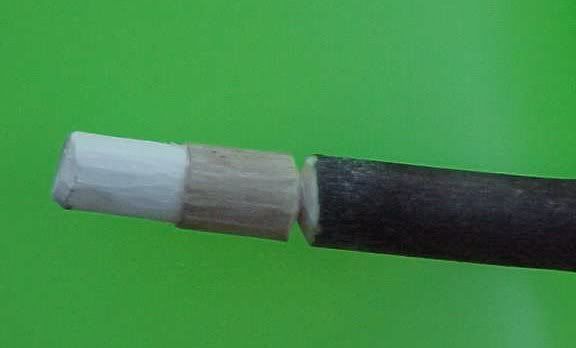 Next time you find yourself sitting around the campfire with your trusty pocket knife handy, grab a branch and make yourself a spare (or replacement) rod cap.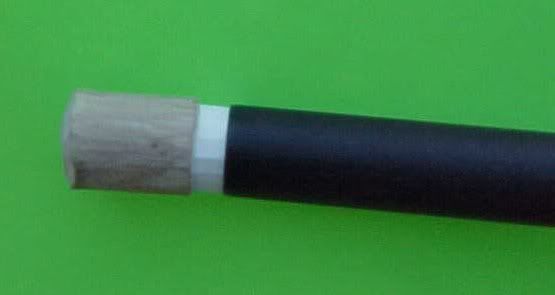
As with all things tenkara, take it slow and easy, use a gentle hand.
Make sure you don't try to force a peg that is too big into a hole that is too small. You could possibly damage you rod. You also need to be sure not to try to force the cap too deep into the rod, remember there are rod sections down there. If you have your current plug handy, you can use it as a template regarding length and diameter.
Thursday, December 8, 2011
 Got a dandy early Xmas gift from a virtual fishing buddy of mine. Alan graciously sent me a copy of his album, The Last Cast. Anyone who enjoys fishing or the outdoors will enjoy Alan's tunes.
 I personally think this is the perfect music to listen to while tying flies. Even if it doesn't improve the look of your flies (but it very well might), it will improve your mood. You can listen to some of Alan's tunes on his website -
http://alancayn.net/music
Subscribe to:
Posts (Atom)
